
TMS Therapy for Depression and OCD When Medication Hasn't Been Enough
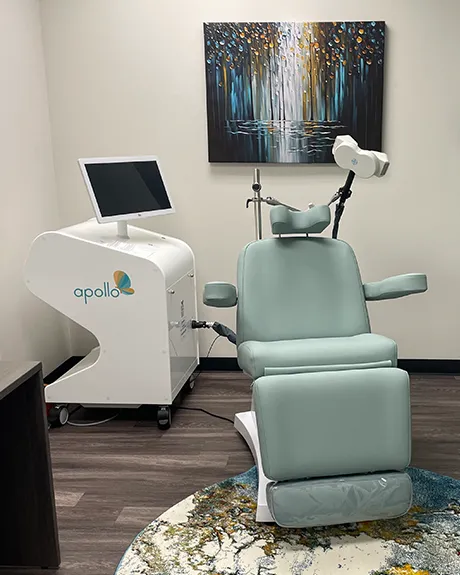
If antidepressants have not worked, that says nothing about your effort or your strength. For about one in three people with depression, standard medications simply do not reach the circuits that are driving it. TMS therapy does. It uses targeted magnetic pulses to stimulate the underactive areas of the brain involved in mood regulation, with no medication, no anesthesia, and no systemic side effects. Most major insurance plans cover it when it is medically indicated.
A Different Approach When Antidepressants Haven't Been Enough
Transcranial Magnetic Stimulation (TMS) is an FDA-cleared treatment for major depressive disorder and treatment-resistant depression. It is also FDA-cleared for obsessive-compulsive disorder (OCD). Unlike antidepressant medications, TMS does not enter the bloodstream. There are no systemic side effects, no weight changes, no sexual dysfunction, and no sedation.
TMS works by delivering precisely targeted magnetic pulses to specific regions of the prefrontal cortex, the area of the brain most directly involved in regulating mood. In patients with depression, these regions are consistently underactive. TMS stimulates neural activity in those circuits, with effects that build cumulatively over the course of the treatment program.
Sessions are conducted in an outpatient setting. Patients sit in a comfortable chair, remain fully awake, and can return to their day immediately after each session. No preparation is required. A standard TMS course involves daily sessions five days per week over approximately six weeks.
How Transcranial Magnetic Stimulation Works
TMS is not experimental. The mechanism is well understood, which is part of why it earns FDA clearance and insurance coverage for the conditions it treats.
Targeting Underactive Brain Circuits
In major depressive disorder, the left dorsolateral prefrontal cortex (DLPFC) is consistently underactive. TMS uses a precisely calibrated magnetic coil placed against the scalp to target this specific region with magnetic pulses at a clinically determined frequency and intensity.
Stimulating Neural Firing
Each magnetic pulse induces a small electrical current in the targeted brain tissue. This stimulation prompts neurons in the DLPFC to fire, gradually increasing connectivity and activity in the mood-regulating circuits that depression suppresses.
Cumulative Neuroplastic Change
The therapeutic benefit of TMS builds over time through repeated stimulation. This process promotes lasting neuroplastic change: measurable improvements in brain activity and connectivity that correlate with reduced depression symptoms, improved energy, and better cognitive function.
TMS vs. Antidepressants: A Fundamentally Different Mechanism
Antidepressant medications alter neurotransmitter levels throughout the entire body, which is why they carry systemic side effects. TMS bypasses the bloodstream entirely, targeting specific brain circuits directly through the scalp. For patients who have not responded to medications, or cannot tolerate their side effects, TMS offers a clinically distinct and well-evidenced alternative.
What TMS Therapy Can Treat
TMS has FDA clearance for specific psychiatric conditions and is also used where clinical evidence supports its use. Your Turnwell provider will review your diagnosis and history to discuss which protocol is most appropriate.
Treatment-Resistant Depression
TMS is FDA-cleared as a treatment for major depressive disorder when two or more adequate antidepressant medication trials have not produced sufficient improvement. This is the most common TMS indication at Turnwell and the condition most likely to receive insurance authorization for TMS.
Major Depressive Disorder (MDD)
TMS is an effective option for patients with MDD who have not found adequate relief with antidepressants or who cannot tolerate their side effects. It can be used as a standalone treatment or alongside ongoing medication management at the discretion of your psychiatrist.
Obsessive-Compulsive Disorder (OCD)
The FDA has cleared a specific deep TMS protocol for OCD in adults who have not adequately responded to medication and behavioral therapy. Turnwell offers TMS for OCD at select locations. A clinical evaluation is required to determine appropriateness.
Anxiety Disorders (Off-Label)
TMS is used off-label for generalized anxiety disorder and related conditions in patients who have not responded to standard treatments. Clinical evidence supports its use, and your Turnwell provider will discuss whether this is an appropriate consideration based on your specific clinical history.
What to Expect from TMS at Turnwell
TMS therapy follows a structured, consistent protocol at every Turnwell location. Here is what the process typically looks like from initial contact through completion of the treatment course.
Consultation and Insurance Verification
Your first step is a consultation with a Turnwell psychiatrist who will review your psychiatric history, prior medication trials, and current symptoms to confirm TMS is appropriate. Our team verifies your insurance coverage and handles prior authorization before your first session begins.
Motor Threshold Mapping
Before your first treatment, your provider conducts a motor threshold assessment to calibrate the correct magnetic field intensity for your individual anatomy. This ensures each session delivers precisely the right stimulation.
Daily Treatment Sessions Over 6 Weeks
TMS sessions are held five days per week, Monday through Friday. Each session lasts 20 to 40 minutes depending on protocol. You sit in a comfortable chair while the magnetic coil is positioned against your scalp. Most patients read, listen to music, or talk to staff during treatment. No preparation required, no anesthesia, no recovery time.
Response Monitoring Throughout
Your clinical team monitors your response throughout treatment. Many patients begin to notice improvements in sleep, energy, and mood during weeks two through four. Full response typically consolidates over the final weeks and continues to improve in the months following treatment completion.
Post-Treatment Follow-Up and Coordination
After your course ends, your Turnwell psychiatrist schedules a follow-up to assess your response and discuss next steps. Some patients benefit from a maintenance protocol. All follow-up care is coordinated by the same clinical team who managed your TMS course.
TMS Therapy at a Glance
Typical TMS Protocol
Most patients complete 30 to 36 sessions over 6 to 7 weeks. Booster or maintenance sessions may be recommended after the initial course for patients with a strong response who wish to sustain improvement. Your Turnwell provider will recommend the protocol best suited to your clinical profile.
TMS Therapy Safety Profile
TMS has a well-established safety record accumulated over more than two decades of clinical use and peer-reviewed research. Its FDA clearance reflects this body of evidence.
Common Side Effects
The most common side effect is mild scalp discomfort or a localized headache at the treatment site during or shortly after the session. This typically diminishes after the first week as the scalp acclimates to the stimulation. Over-the-counter pain relief is usually sufficient when needed.
No Systemic Side Effects
Unlike antidepressant medications, TMS does not enter the bloodstream. There is no weight gain, no sexual dysfunction, no sedation, no gastrointestinal distress, and no cognitive impairment. Most patients report no change in daily functioning during the entire treatment course.
Rare Risks and Contraindications
The most serious potential risk of TMS is seizure induction, which is rare and occurs in approximately 1 in 10,000 treatment sessions. Certain metal implants in or near the head represent a contraindication. Your Turnwell provider conducts a thorough safety screening before treatment begins.
TMS Therapy Is Covered by Most Major Insurance
We verify your TMS benefits and handle prior authorization before your first session begins.
TMS coverage typically requires documentation of two or more adequate antidepressant medication trials without sufficient response. Coverage varies by plan and clinical criteria. Contact us to verify your specific TMS benefits.
Where to Receive TMS Therapy at Turnwell
TMS therapy is available at three Turnwell locations. All three offer board-certified psychiatric oversight and handle insurance verification and prior authorization.
Alpharetta, GA
Charleston, SC
Tampa Bay, FL
If you or someone you know is in crisis, please call or text 988 (Suicide & Crisis Lifeline) or go to your nearest emergency room. Turnwell is not an emergency or crisis facility.
Call 988 NowTMS Therapy: Your Questions Answered
What is TMS therapy?
Is TMS therapy covered by insurance?
How many TMS sessions will I need?
What does a TMS session feel like?
Who is a good candidate for TMS therapy?
What are the side effects of TMS therapy?
How effective is TMS therapy for depression?
Can I continue taking antidepressants during TMS?

See If TMS Therapy Is Right for You
A consultation with one of our board-certified psychiatrists takes the guesswork out of it. We review your treatment history, confirm whether you meet candidacy criteria, verify your insurance benefits, and answer every question you have — before anything is scheduled. There is no pressure and no obligation. Most patients are seen within a few days of reaching out.